
Waterloo Address History by Era
The best source changes with the date. Modern parcel and deed tools lead into county transfer books, land and town-lot indexes, and then local directories and newspapers. The online AVA start year was not stated, so a missing web result is not a proven gap.
| Source | Years covered | Where held | What it can show |
|---|---|---|---|
| Recorder abstracts and index | 1842-1942; index 1850-1892 | SHSI / county custody | Condensed instrument trail and index references |
| Land and town-lot deeds | 1853-1902; 1855-1901 | SHSI / Recorder | Recorded parties, land or lot, instrument |
| Auditor transfers | Land 1866-1988; town lots 1880-1988 | SHSI / Auditor series | Bridge between deed eras |
| Waterloo city directories | 1873-1991 listed by WPL | Waterloo Public Library | Dated name and address clues |
| Modern land records | Coverage start not stated | AVA and Iowa Land Records | Indexed deeds, mortgages, releases, images when available |
Keep a recorded-interest timeline and an occupancy-clue timeline. Previous residents may appear in one without appearing in the other.
Trace Waterloo Deeds Backward
Start with the modern PIN and legal description, not just the street name. A legal description identifies land through lot, block, plat, section, or other recorded terms and often survives changes to a mailing address.
- Confirm the civic address in Waterloo Address Points and collect the parcel PIN and legal description from city or county mapping.
- Find the newest recorded deed through AVA or Iowa Land Records, saving its date, parties, type, number, and book or page.
- Take the seller, or grantor, and search that person as a prior grantee within an earlier date range.
- Repeat the party search in both roles, check mortgages and releases, and match the legal description at each link.
- When web coverage ends, request the named index, volume, or reel from the Recorder, SHSI, or FamilySearch.
- Grantor
- The party transferring an interest in a recorded instrument.
- Grantee
- The party receiving the recorded interest.
- Chain of title
- The linked sequence of transfers affecting the same legal parcel.
- Legal description
- The recorded land description used to hold the chain together when addresses change.
The Recorder duties and services page confirms the office's broad land-record set.
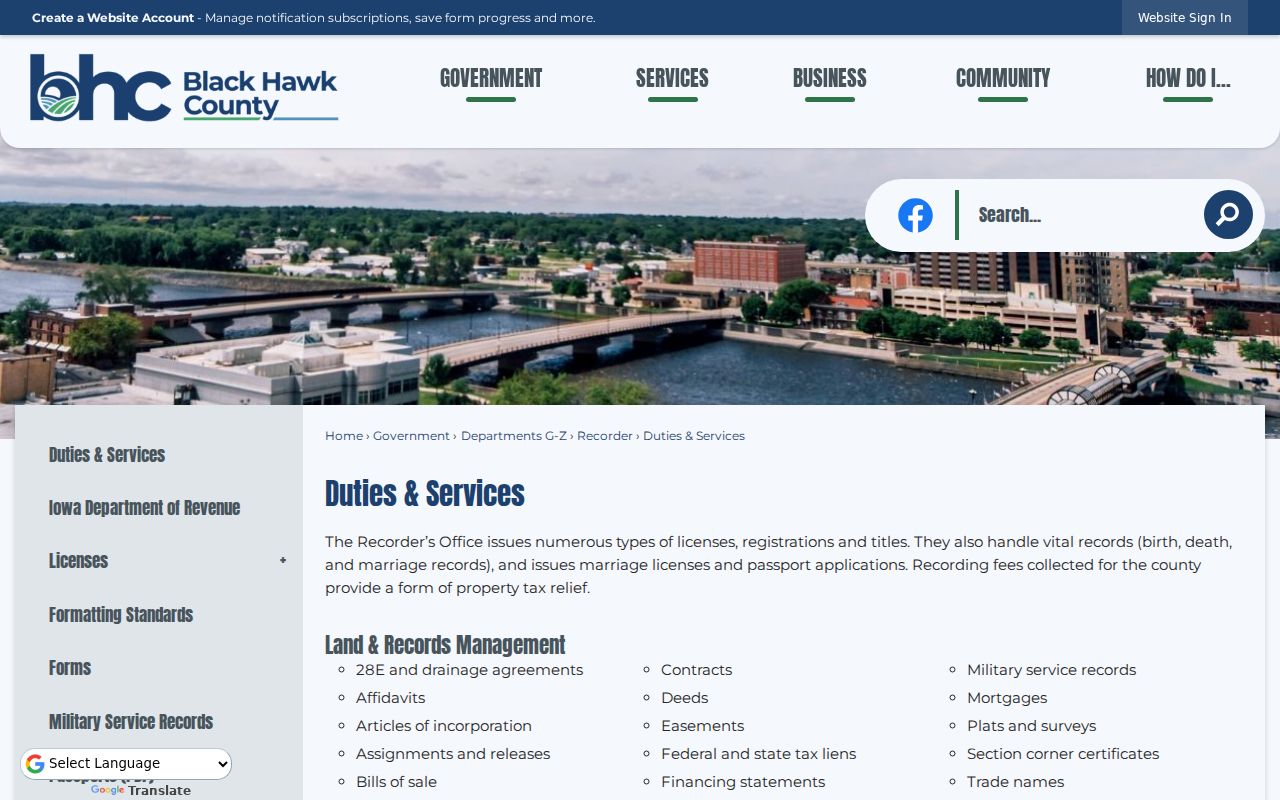
The listed deeds, contracts, mortgages, assignments, releases, affidavits, liens, plats, and surveys show why one transfer seldom tells the whole story.
Search Waterloo Land Record Parties
Iowa Land Records supports free basic searching across all counties. Select Black Hawk County first. The basic screen accepts a recorded date range, grantor or grantee role, last and first name or a full company name, and document types. At least one criterion is required.
The “Show One Result Per Land Record” control changes the output. Leave it checked for a compact instrument list; clear it to expose all matching parties. Advanced registered search may add parcel ID, property data, book, page, and document identifiers. Limited daily document views may apply.
The Iowa Land Records county selector is the verified entry for Black Hawk searches.
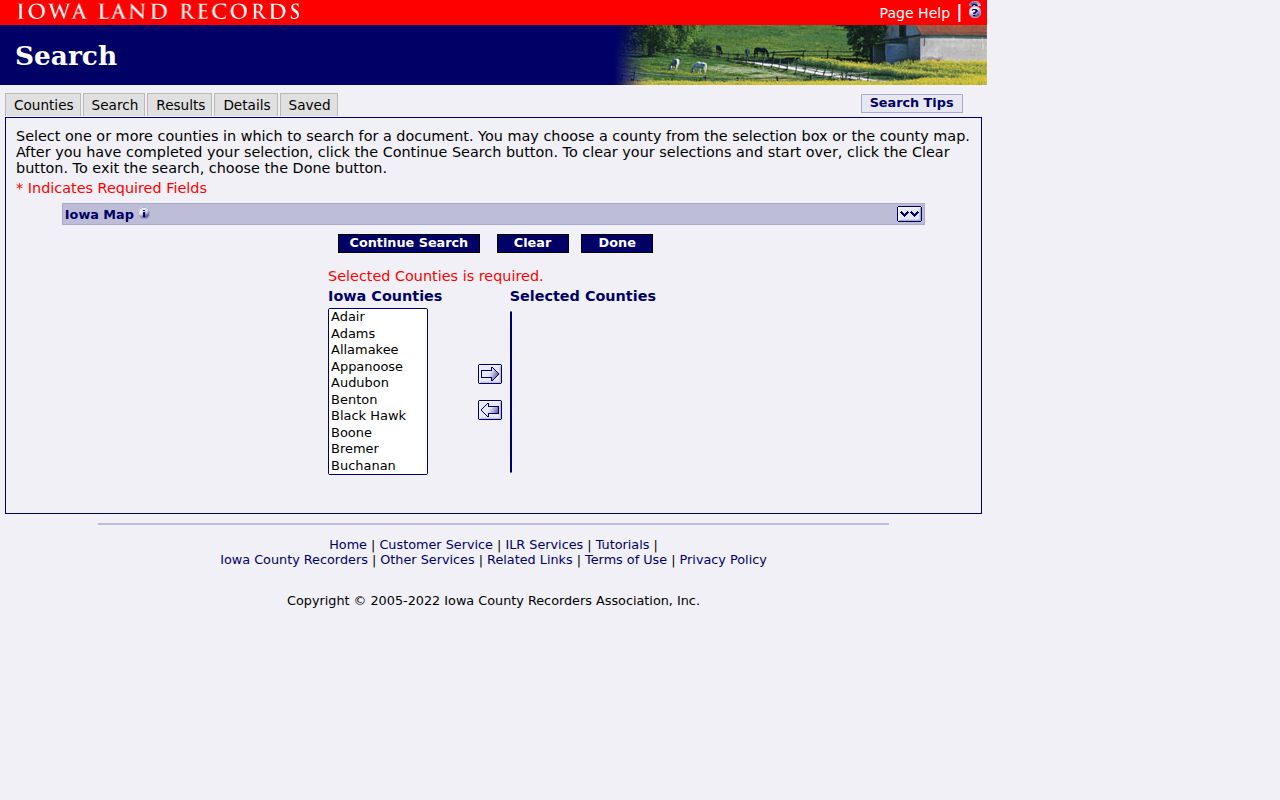
This screen begins a county-specific chain; it does not state Black Hawk's earliest online image year.
Bridge Waterloo Deed Eras
SHSI's Black Hawk holdings fill named historical spans. Land-deed indexes and records run 1853-1902, town-lot series 1855-1901, original-entry abstracts 1849-1856, and homestead records 1870-1986. Auditor transfer books then carry land transfers from 1866-1988 and town lots from 1880-1988.
Choose land versus town-lot material from the legal description. Search spelling variants, initials, and surname-first forms. An index points to a book or instrument; it is not the original document. Cite the series, span, volume or reel, page, and custodian so another person can reproduce the step.
Order Waterloo Record Copies Precisely
A copy request works best after the index supplies an instrument, volume, or page. The Black Hawk Recorder lists most legal documents at $7 for the first page and $5 for each added page. Uncertified copies are $1 per page, certification is $5, and email adds $2 plus the copy charge. Confirm the schedule before ordering.
The Recorder fee and requirement page is the source for current copy terms.
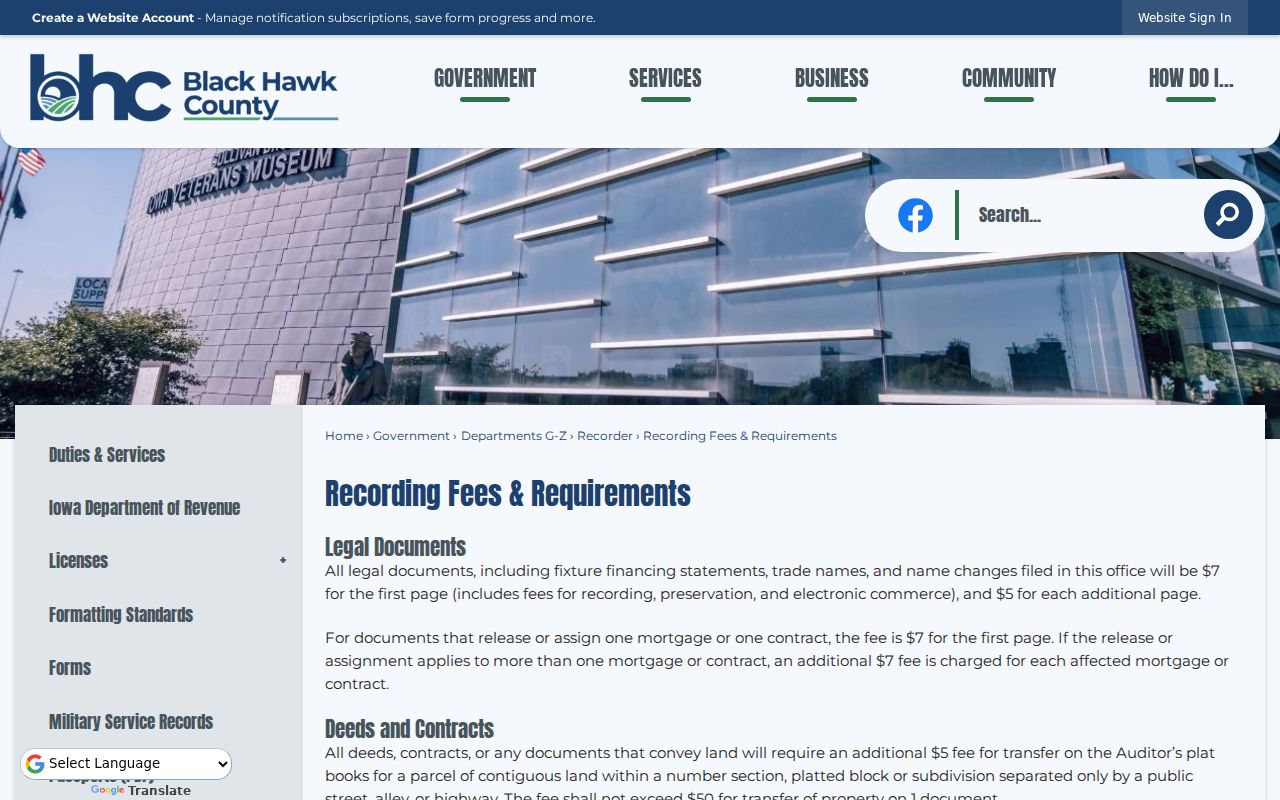
The fee page marks the point where an index lead becomes a document request. It does not establish ownership or occupancy by itself.
Confirm Waterloo Past Households
A deed names recorded parties, not every person who lived there. Match each transfer date to the closest Waterloo directory year, then check Courier microfilm, an obituary index, probate files, or a federal census where available. The WPL directory run is listed as 1873-1991. Grout lists selected recent volumes from 1998 onward, with some intervening years not listed rather than proven absent.
Use a simple flow: deed date → nearest directory edition → newspaper notice → probate or vital index. Preserve exact spelling and page citations. A directory may lag a move, omit a household, or list a business. An obituary may give only a last-known place. The Waterloo city directory collections provide the shelf detail needed for that cross-check.
Lawful use. Research Waterloo previous residents for house history, genealogy, or estate work. Never use an address trail to track or harass a living person.
Place Past Waterloo Homes on Maps
Grout's appointment-only archives list Waterloo maps from 2006 onward, Sanborn maps from 2000 onward, plat maps from 1999 onward, and street-scene photographs. WPL supplies local-history books, directory material, and Courier microfilm. These collections can show a building, lot, street scene, or institution near the address.
Do not guess that a present PIN equals an old lot reference. A split, new plat, correction, boundary agreement, or partial release can change the legal description. Preserve both forms and identify the recorded instrument that bridges them. Map evidence supplies context, while the Recorder supplies the instrument trail.
Waterloo Records Predate the County
The Recorder's office traces its territorial origin to 1839, four years before Black Hawk County formed in 1843. Cedar Falls first held the county seat; Waterloo later won the east-west courthouse rivalry. Those dates explain why early material can be cataloged by territory, county, office, or archive rather than by today's courthouse address.
The practical lesson is simple. Name the office and series, not merely “courthouse records.” County custody, an SHSI reel, a FamilySearch image, and an online index can describe the same record through different formats. No inspected official source reported a courthouse fire that erased a known span, so do not fill a search gap with that rumor.
Document Waterloo Previous Residents
For each link, save the address form, legal description, PIN, party role, document type, recording date, instrument number, book or page, image status, source URL, and access date. For occupancy clues, also save the directory title, edition year, page, and wording as printed.
Mark conflicts instead of smoothing them out. A deed may follow a move by months. Tax mail can go elsewhere. A directory may reflect an earlier canvass. A careful previous-residents timeline shows those gaps and states when evidence proves only ownership, only a mailing route, or only a dated address listing.
For a name change or uncertain identity, widen the cross-check without merging people on a surname alone. Black Hawk archival holdings include probate indexes and records, naturalization declarations and an index, marriage records, and vital indexes with stated spans. A probate file may connect heirs to an estate; a naturalization record may supply a former name or residence; a newspaper notice may link a party to an event. Each is supporting evidence, not permission to infer a continuous stay at the house.
When a requested image is unavailable online, ask for an existing record with a narrow description: Black Hawk County, approximate dates, instrument type, legal description, and the index volume or page. Iowa public-records guidance does not require an office to create a new history or perform open-ended research. A focused request is easier to price, review, and reproduce.